

Bulgarian Rose Oil
Rose otto is the beautifully fragrant essential oil extracted from the species Rosa damascena, and it holds a special place in the hearts of all who love aromatherapy and natural perfumery. There is quite simply, no other essential oil quite like it in terms of fragrance and wealth of therapeutic healing benefits.
It may be hard to believe, but of all the places in the world where roses are cultivated, there are only a handful of regions in just 2 countries that provide just the right conditions to grow this incredible flower in large enough quantities to produce rose otto essential oil! One such area is the 'Valley of the Roses' in Bulgaria, and the others are in Turkey - and both are connected by history.
Origin of the rose
The particular variety of rose grown to produce rose otto oil in both of these countries is Rosa damascena forma trigintipetala, and its parentage has been the subject of great debate for many, many years. At one time it was believed to be a horticultural hybrid of Rosa gallica and Rosa canina that had escaped cultivation, but recent advances in identifying plant genetics has suggested it is more likely to be a hybrid of R. gallica and R. phoenicia.
The origin of the cultivated rose is often quoted as the Gulf of Persia, which is now known as Iran. From the 10th to the 17th century the rose industry was developed and dominated by Persia, and particularly in Shiraz, the famous city of poets and oriental culture.
From here the rose industry spread into Arabia, Mesopotamia, Palestine, Asia Minor (Anatolia) Greece, India, North Africa, and due to the conquering Moors reached as far as Spain. According to legend, in the 13th century R. damascena was brought from Damascus to Southern France by the returning Crusaders, although some experts believe it may have actually been R. gallica instead.
Valley of the Roses
During the 16th century, Ottoman (Turkish) merchants imported R. damascena for cultivation throughout the Balkan countries, including a newly founded town in Bulgaria that would eventually become known as Kazanlik. Kazan is the Turkish word for 'still', and Kazanlik literally means 'the place of stills'.
A nearby valley provided the perfect environment for growing roses, thereby establishing what would in later years become what many experts consider the finest rose oil producing region in the world. This area is now called the 'Valley of the Roses', and during 1878 cuttings from the improved stock were returned to Anatolia and planted in Isparta and Burdur, where current rose production still thrives.
Throughout the 19th century, the Bulgarian rose oil industry reigned supreme, almost monopolising the entire world supply of rose oil. This monopoly would not be broken until the industry was nationalised due to dramatic changes in the political and economical climate after World War 2, when production fell into a steady decline. Today, it is believed that Turkey holds the record as the largest producer of rose otto, and only the oil from this country matches the quality and fine fragrance to that of Bulgaria.
Climatic conditions
In Bulgaria, the rose blossoms of Rosa damascena begin to bloom around the third week of May, and will continue for three or four weeks depending upon climatic conditions. The yield of oil can be dramatically affected by the prevailing weather conditions - for example during very hot and dry weather the harvest may last only two weeks and the yield of the oil is lowered due to loss by evaporation. Conversely, during mild and humid weather the harvest time can be extended whilst at the same time increasing the oil yield.
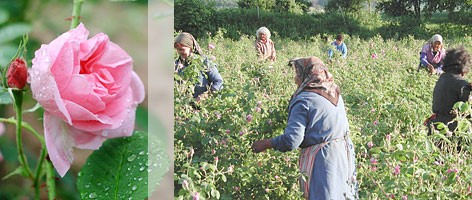
The harvesting season starts as soon as the flowers begin to open and continues until all the roses have been gathered. In Bulgaria and Turkey the blossoms are still collected by hand in the time-honoured way, and are nipped just below the calyx (the green, outer protective cover). Collection begins at sunrise when the oil yield is at its highest, and should be completed by 10.00 am whilst the dew is still on the flowers. The flowers are initially placed into baskets, and then transferred to sacks for transportation to the distilleries.
Time is of the essence
Whilst the harvesters are picking the flowers, other workers carefully transfer the flowers from the baskets to the transportation sacks where they are weighed, and all the relevant details are recorded since harvesters are paid by the weight of flowers picked. Each sack weighs approximately 25 kilos when full and is loaded onto horse drawn carriages, the backs of donkeys or less commonly, trucks!
The harvest is then transported to the distillery as quickly as possible, since the picked flowers will begin to deteriorate immediately as precious volatile oil begins to evaporate due to the heat of the sun. This in turn of course will lower the yield of the crop and push up the price of production.
Extraction
In Bulgaria during the early 1900's, virtually all rose oil was distilled on-site using direct-fire stills operated by the farmers. A suitable site would be chosen adjacent to the field and near a stream and the apparatus would be set up. Although this sounds rather primitive, the yield produced from this type of amounts to 1 kilo of oil for every 2,500 to 3,000 kilos of roses. Amazingly, this is a considerably higher figure than can be achieved by modern industrial distillation techniques!
Modern stills are made of copper and are heated with an open wood fire from below. The roses can not be distilled in the usual way by directly injecting steam, because the petals compact to form a large mass that the steam can not penetrate. Therefore the distillation techniques have been refined in various ways to overcome this problem.
During distillation a large amount of oil is absorbed into the distillation water, and this is known as the 'First Water'. The rose oil must be recovered from this water to produce an acceptable yield, and this is achieved by skilfully re-distilling the water to separate the oil; a process known as cohobation.
The amount of oil produced directly from distillation is as low as only 20% or 25%, the majority being recovered from the distillate water by cohobation. This ratio does vary depending upon certain factors, but is usually in the region of 25% 'direct oil' and 75% 'water oil'. The 'Second Water' remaining after the process of cohobation is then sold as rose hydrosol (aka floral water) or re-cycled in the still for the next batch of flowers.
The total yield of oil will depend upon several conditions; climate, the time of the harvest, condition of the flowers and the method of distillation. During the middle of the harvest period the yield is higher than at the beginning, and mild weather will result in a further increase in the oil produced.
On average, Rosa damascena will yield 1 kilo of oil per 4,000 kilos of flowers using modern distillation processes. Under very favourable conditions only 2,600 kilos of roses may be required to produce 1 kilo of oil, whereas under less favourable conditions up to 8,000 kilos of flowers may be required to produce the same amount of oil.
Copyright © Quinessence Aromatherapy Ltd 2002. Written by Geoff Lyth
If you enjoyed this article, please click the 'Like' button and help spread the word:
Next Chamomile Roman Oil